Friday, 19 April 2019

Good Friday: Jesus Remember Me


We’ve had a really special time of worship here today. I’m really grateful to Canon Sarah who has led us this week. It’s rare to receive Holy Week in my profession.

We were in church for three hours of devotion which included two hours of interactive prayer round the stations of the cross. As in every service this week I waited for some words from the story to hit me. 

The criminal who hung by Jesus’ side at the crucifixion saw something in him others did not see. Not a heretic but the herald of a new era. Not a criminal but a king. “Jesus, remember me when you come into your Kingdom” he cried. 


Surely that’s our prayer and our hope on Good Friday. 

Jesus remember me...
Remember my pain...
Remember my worth...
Remember your promise...
Remember my name...
Remember me today... in what I face.

Jesus remember me...
Let me leave my life and what I can’t sort myself at your cross...
As I stand by it help me to remember you are with me always in the darkness as well as the light that will come.

Jesus remember me...
When others don’t remember me...
When I feel like I’m on my own...
When the world feels too much to bear...
Remember me and all those who feel lost. 

Jesus remember me when you come into your Kingdom.
On this Good Friday we worship and we watch and we weep and we wait...
Jesus remember me and give me your promise of paradise. 



The Archbishop of Canterbury puts it better than I can writing about the point of today: 
Today is the most confrontational and difficult day in the Christian story. 

The Crucified God tells us that the human problem of sin is too serious to be dealt with by us alone. It needed God himself to carry the pain and cost of sin. 

To understand what Good Friday means for us all – for the whole world – we have to do the hard work of reflecting on the pain and despair that Jesus felt on the cross and on our contribution to his crucifixion. 

We have to be willing to hear his cry: “My God, my God, why have you forsaken me?” 

That cry was his in order that it need not be ours.
 
That cry echoes through the centuries. That cry tells us what it means for God to love us so much that he become one of us. More than that it tells us of the cost of sin, of the darkness that our choices bring over the earth, and which is absorbed into his light. 

Another cry from the cross comes at the end: “It is finished." 

Jesus means, it is completed. The work of the cross has been entire, and he has done all his work. In John’s gospel the cross is seen as a moment of triumph, for through it life is offered to every human being. 
 
On the cross, Jesus knew all our pains and guilt – so that we would never again be alone in facing them. So the message of today is this: we are offered hope. Wherever each one of us is: in light or darkness, in joy or pain, God is with us. 

As we move through the final days of the Easter story, I pray that you know the comfort of God’s presence, his hope and his forgiveness – today and always.


Jesus, remember me...
At one of the prayer stations was this poem. I stood and read it over and over. Think deeply on it. It’s great! We all matter..

Mrs. Nelson explained how to stand still and listen
to the wind, how to find meaning in pumping gas,

how peeling potatoes can be a form of prayer. She took
questions on how not to feel lost in the dark.

After lunch she distributed worksheets
that covered ways to remember your grandfather’s

voice. Then the class discussed falling asleep
without feeling you had forgotten to do something else

something important—and how to believe
the house you wake in is your home. This prompted

Mrs. Nelson to draw a chalkboard diagram detailing
how to chant the Psalms during cigarette breaks,

and how not to squirm for sound when your own thoughts
are all you hear; also, that you have enough.

The English lesson was that I am
is a complete sentence.

And just before the afternoon bell, she made the math equation
look easy. The one that proves that hundreds of questions,

and feeling cold, and all those nights spent looking
for whatever it was you lost, and one person

add up to something.


Thursday, 18 April 2019

Maundy Thursday: Wrestling


We’ve just commemorated Maundy Thursday in church, with a remembrance of the Last Supper; Jesus washing his disciples feet, stripping the altar to remember the bareness of the events that were to come, and then an invitation to watch in the darkness to remember the garden until midnight. I baled out at 10.20, not feeling brilliant but Lis is still there as I write (11.30) - she’s a much better Anglican than me :) 


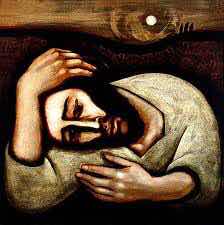
As I sat in the silence and watched for a while, the bit of the story I was thinking about was Jesus alone in the garden. After the supper he’s been abandoned, the disciples can’t even watch with him for an hour. I lasted an hour and twenty minutes! 

Then he withdrew from them about a stone’s throw, knelt down, and prayed, “Father, if you are willing, remove this cup from me; yet, not my will but yours be done.” Then an angel from heaven appeared to him and gave him strength. In his anguish he prayed more earnestly, and his sweat became like great drops of blood falling down on the ground. (Luke 22:41-44)

I think Jesus is petrified. He knows what is coming. He also is deeply lonely. Don’t we need our friends when all feels lost? Those he thought got it, have now deserted him. He maybe also feels a failure. Despite three years of hard work trying to convince people of his message it has come to this. He wrestles with God. He doesn’t want what is ahead - who would? 


When we have those moments we are in our own garden, don’t we have those questions that make us wrestle in our mind? 
How did I get here and how do I get out of here?
Why have things gone so badly wrong?
Perhaps if I’d done things differently...
What is your will for me now, God? 

I’ve just reread Luke 22 as I thought about what to write for tonight’s blog and I’d never really noticed an angel appearing at this point in Jesus’ passion. Angels have a habit of turning up when we need reassurance or a firm telling to not be afraid. When Jesus is alone in the wilderness facing Satan and his wiles, an angel ministers to him, and now, as he suffers indescribable torment, an angel gives him strength. Amazingly, when most of us would have given up, and told God to stuff it, he submits himself to God’s will, knowing the cup of suffering cannot be taken away.


Tonight I’m not in a garden as bad as Jesus was, but I am in one. I ponder what the will of God is for me. I worry about the future. I feel guilt that torments me a lot having curtailed my ministry in Hastings, letting a lot of people down. I never wanted to be here, waiting for the wider Church to decide what it is going to do with me and seeming to take ages to tell me. Can I really say “yet not my will but yours God” when I thought it was clear what that was and now it isn’t? 


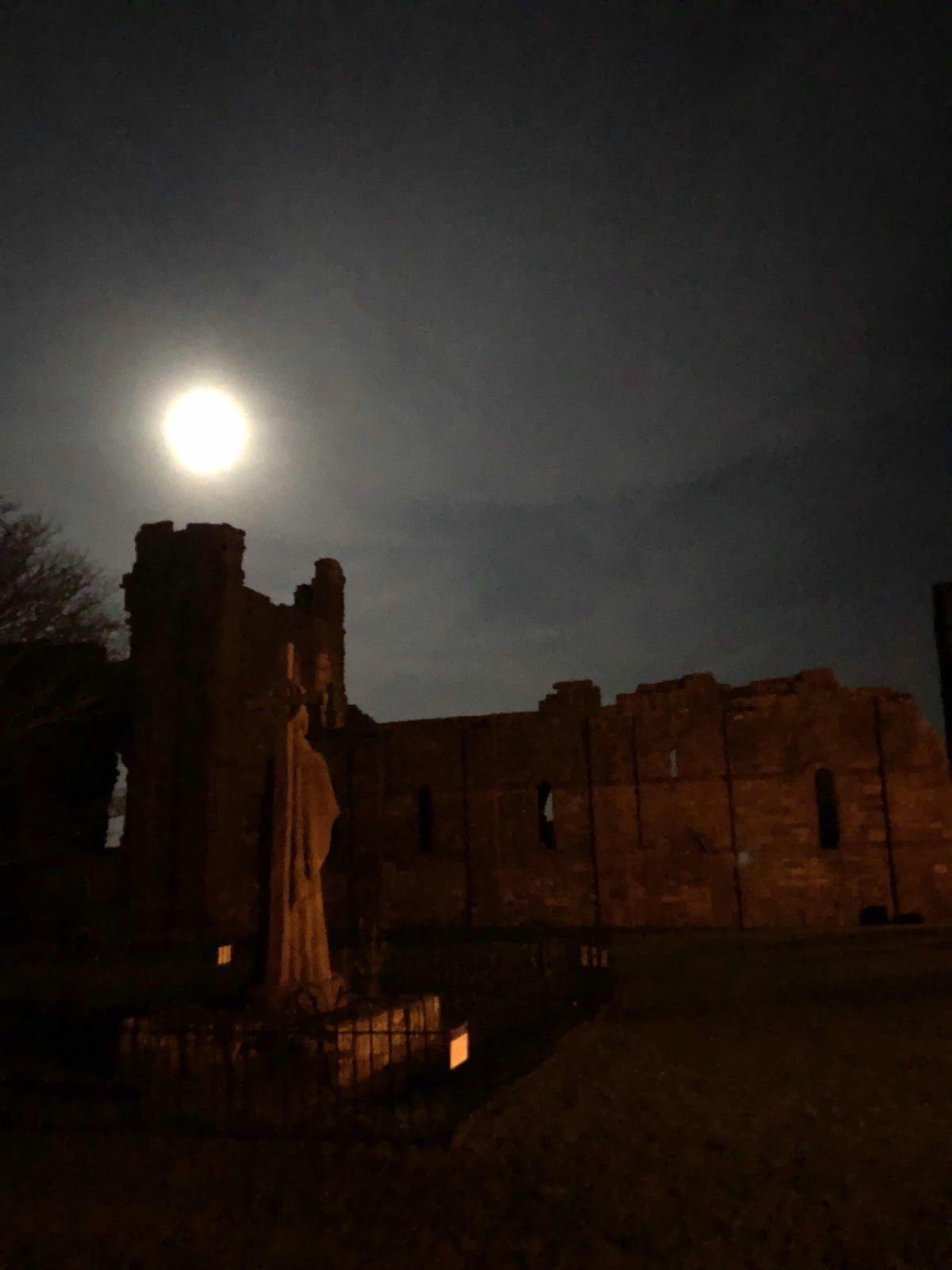
Walking out of church tonight I noticed the moon lighting the way. The light was bright. Perhaps a parable that in whatever darkness, torment and uncertainty we face, we are held by a greater presence. Tomorrow we shall remember as Jesus goes to a cross there is no experience that God doesn’t face with us. That God dies on a cross is the beginning of knowing the dregs of human experience are never outside his love and care. 

Holy Week: Maundy Thursday

Jesus our brother,
once you knelt sleepless
in the darkness of a garden
alone
and wept and prayed,
sweating, bleeding,
with the pain of powerlessness
with the strain of waiting.
An angel offered you strength -
but it was a bitter cup.

We pray for all
who wake tonight
waiting, agonising,
anxious and afraid,
while others sleep:
for those who sweat
and bleed, and weep alone.
If it is not possible
for their cup to be taken away -
then may they know your presence
kneeling at their side.

 'Gethsemane Prayer' © Jan Sutch Pickard taken from 'Lent and Easter Readings from Iona' 


Wednesday, 17 April 2019

The Wednesday of Holy Week: Hard choices


Bonhoeffer seems to be coming into sermons a lot this week. The story of Germany in the 1930’s is an interesting one about humanity latching on to an ideal offered to them that following it life will be better. Hitler offered perfection and prosperity - the wiping out of the different was for some, swept up in the promises, a small price to pay even if they thought about it. The message that “we are better” and “we get rid of them” is horrific. 
Bonhoeffer and others took a stand against it and it cost them their life.

“Christians in Germany will have to face the terrible alternative of either willing the defeat of their nation in order that Christian civilization may survive or willing the victory of their nation and thereby destroying civilization,” he wrote.

One of my friends this morning posted this:


We live in frightening times. We seem to have learnt little. To follow an ideal, a leader without realising the consequences of the message is dangerous. We seem to be moving to “we are better” and “get rid of them” again. 

Holy Week is a story of deciding what we will choose. The Roman regime was brutal, but to challenge it could cost you your life. When Jesus entered Jerusalem people were confronted with a
stark choice: two distinct kingdoms; force and threat or peace and love. The trouble was the majority saw Jesus as a threat, a heretic, a rabble rouser so it was easier to get rid of him. We might know the Romans, the Nazis, the unjust today are wrong, but it’s easier to put up with them than choose publicly to support another way. This week do we crucify him through not speaking out or do we discover our prophetic call to be different? 


It’s hard to speak out, it’s hard to stand out from the crowd, but for the world to change we need to be more courageous. “Don’t get involved in politics” the Church is told. But if we don’t get involved and we don’t live in the world and try to change it then we’ve lost the point. It’s isn’t easy to speak out, it doesn’t make you popular...


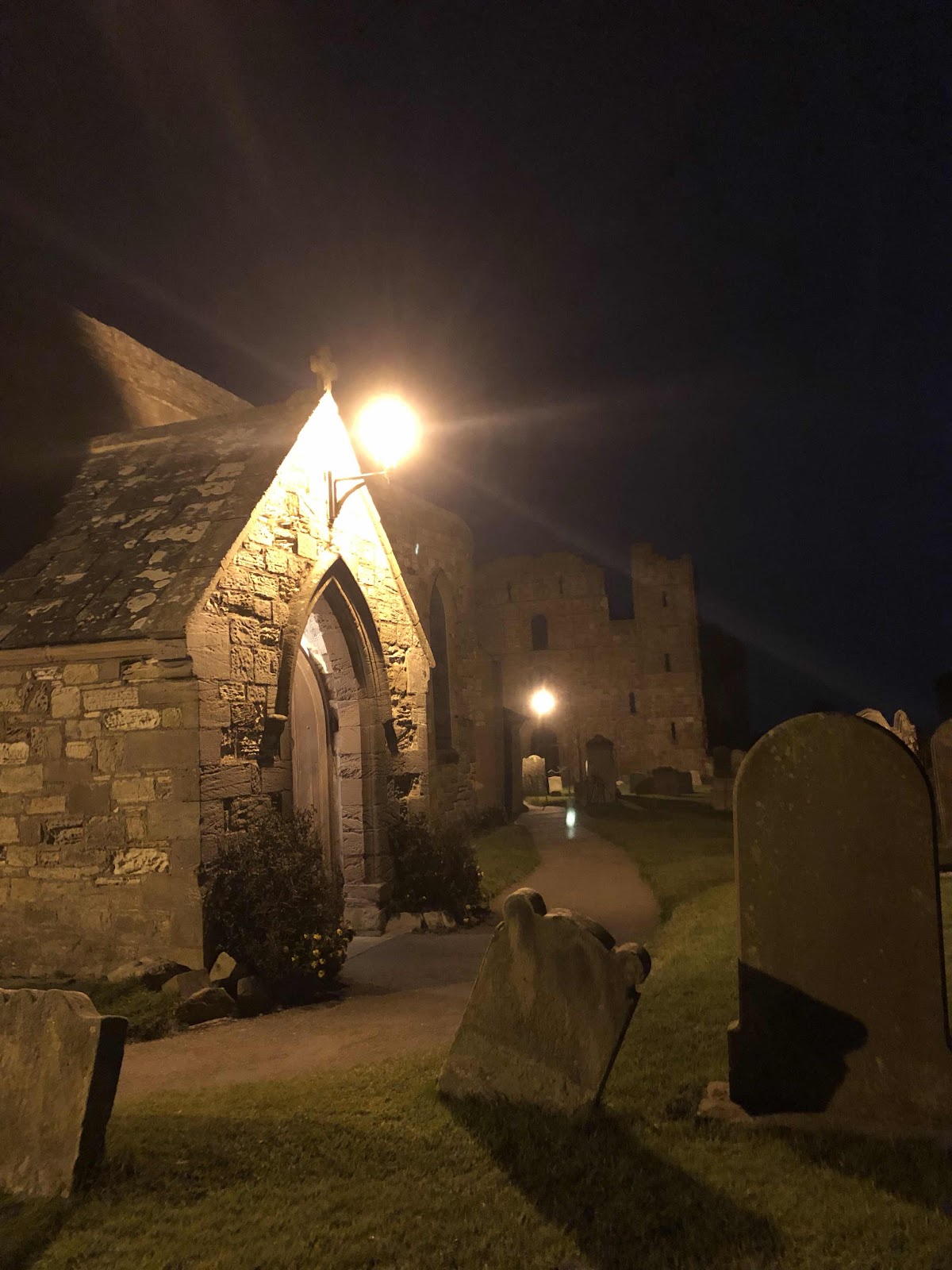
Tonight on my walk I passed the priory on Lindisfarne. The Vikings attacked the island msjy times but the holy community persevered on Lindisfarne, though the monastery was mostly abandoned in AD875; the majority of monks sensibly fleeing, taking the sacred relics of St Cuthbert with them. They held firm to their beliefs when it was easy to give up.

On this Wednesday of Holy Week, we thank God for the outspoken and we pray when we need to have courage we might be given strength to do what is right. 

Tuesday, 16 April 2019

The Tuesday of Holy Week: Come and die


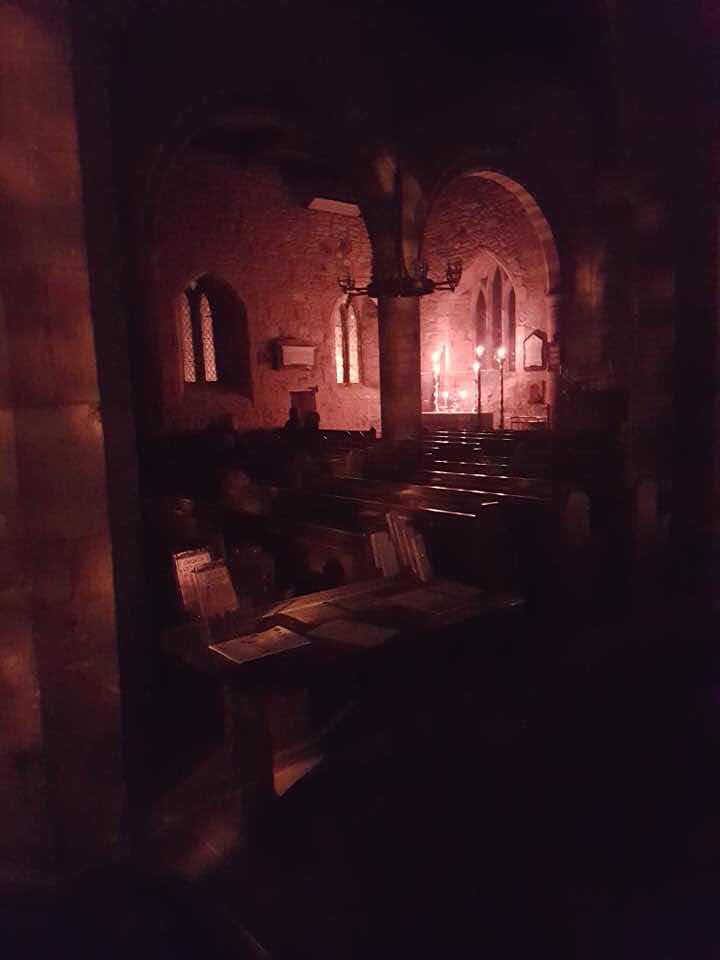
I stood tonight after night prayer here in the church on Holy Island looking over to the cross on St Cuthberts Isle. I’m led to reflect tonight on the call on Christ’s church in Holy Week to be a cross centred authentic community. 

Perhaps the best text to consider the challenge of the cross is The Cost of Discipleship by Dietrich Bonhoeffer. 

He writes: “The cross is laid on every Christian. The first Christ-suffering which every man must experience is the call to abandon the attachments of this world. It is that dying of the old man which is the result of his encounter with Christ. As we embark upon discipleship we surrender ourselves to Christ in union with his death—we give over our  lives to death. Thus it begins; the cross is not the terrible end to an otherwise god-fearing and happy life, but it meets us at the beginning of our communion with Christ. When Christ calls a man, he bids him come and die. It may be a death like that of the first disciples who had to leave home and work to follow him, or it may be a death like Luther’s, who had to leave the monastery and go out into the world. But it is the same death every time—death in Jesus Christ, the death of the old man at his call.”

“When Christ bids a man, he bids him come and die.” 

We don’t go to church to die! But perhaps we need to. When we come face to face with God in the silence of worship, we are confronted with our selfishness and desires and how far we are from sacrificial living. We want what we want! But perhaps what we want needs to die. 


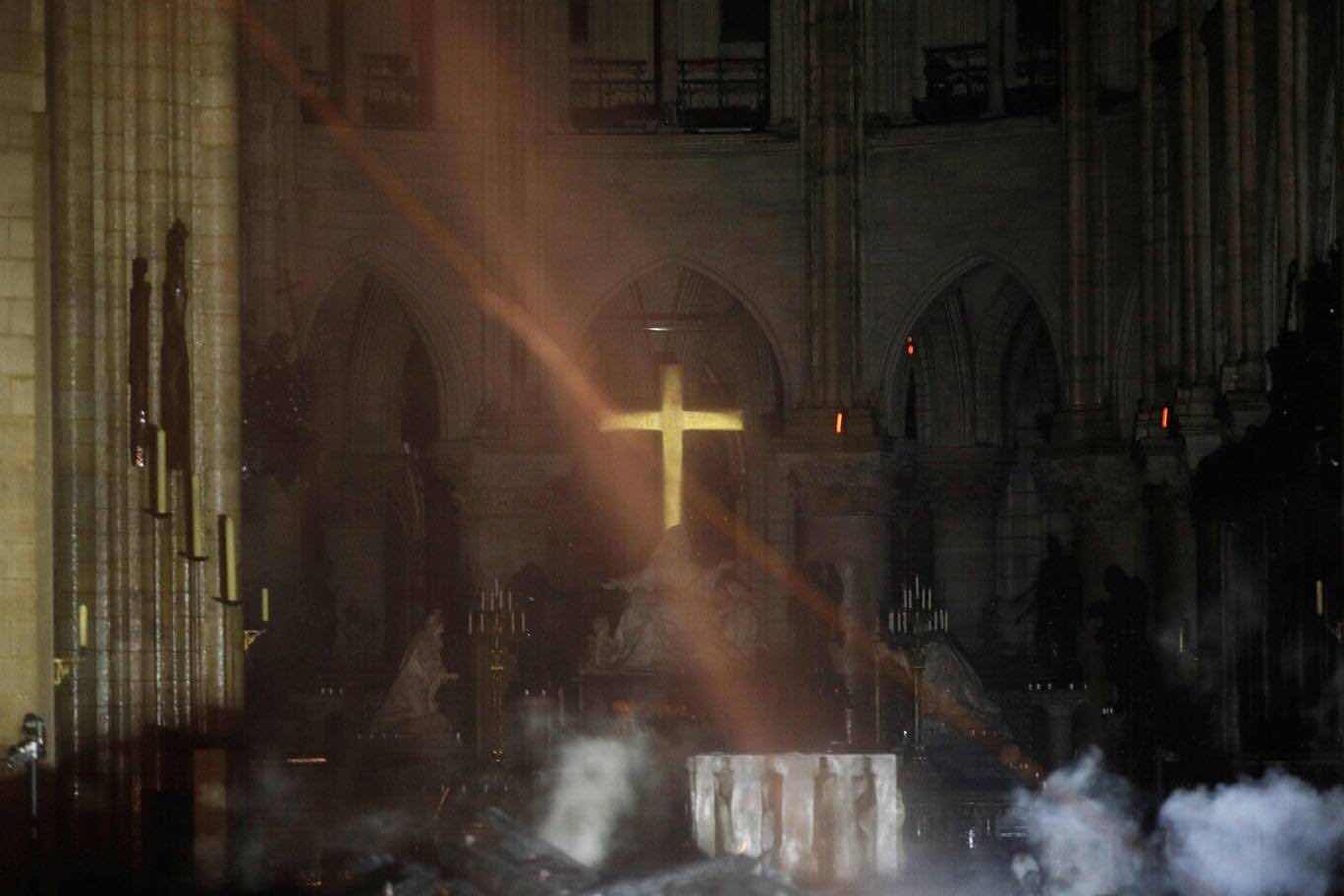
 The cross standing in the midst of the fire in the Notre Dame is a powerful image. A lot of what that building stood for has died in the flames but out of the tragedy new life can come. The cross stands at the heart of suffering.

Canon Ian Black, one of the canons at Peterborough Cathedral writes very helpfully in the context of this week: “Tonight a Cathedral has been seriously damaged by fire - the full extent is yet to be revealed. Churches stand as symbols of stability, security and the soul of life. To see one on fire shakes us to the core.

This is the holiest week of the year when we journey to the cross with Christ. As we do we are reminded of our mortality where we come from dust and to dust we return. We make our progress not in despair but in the hope of the resurrection that comes through Christ. 

Good Friday holds our sorrow and real grief, and all for whom Notre Dame stands for so much will feel that acutely. But Good Friday is itself held in hope by the life giving and restoring power of Easter. 

For all who mourn and grieve may this week be a journey from death to new life.”

Can we this week come and die in order to find new life? What needs in your life tonight to die in order for new life to come? Where do you need to be sacrificial rather than getting all you want?

Over the last few months I have not got what I wanted. I didn’t want to leave my appointment in Hastings. It was going well! But circumstances have meant I’ve had to let it die. It’s painful and it hurts and tonight I don’t know what the future holds. I need help to walk the journey of bereavement and yes, death. But I believe at the foot of my own cross this week new life can come. I have to!

 Someone wrote this to me the other day: “Your ministry still continues to offer solace to others Ian even if you are not in church, do not underestimate the good you do so quietly.” 
There is a future, while there is still uncertainty - I don’t know where we will be living and what shape ministry is going to take but I’m glad of those who stand at the cross with me.

We need a cross shaped Christianity urgently. We need to focus on what Christ leads us to rather than our own agenda. When we let things go and stand at Calvary God can speak to us. If we always get what we want then we will never be open to new possibilities and if we aren’t prepared to see what dying might lead to we aren’t really doing it right, are we? 


Monday, 15 April 2019

The Monday of Holy Week: Lament


The reading for morning prayer today was from the first chapter of the book of Lamentations, a beautiful and honest piece of writing. That Jesus laments is really good news for us as it proves he lives the same life as us. 

“Is any suffering like my suffering...that the Lord inflicted on me...?”

That sounds just like what Jesus must have felt, doesn’t it? You can imagine him framing that question in his mind, wanting to fling it at those who passed him that day in Jerusalem, as he was led through the busy streets carrying a cross, and then, just outside the walls, was lifted high—stretched out, nailed, and naked for all to see. “Is it nothing to you, all you who pass by? Look around and see. Is any suffering like my suffering...?”

 Those words were written about six centuries before Christ, by another sufferer in Jerusalem —some anonymous Jew who had survived (barely) the devastating siege and total destruction of the city by the Babylonian army. The poems that make up the book of Lamentations were composed by the shocked and shaken. The poems were ancient already in Jesus’ time, and almost certainly he knew them. So it is appropriate that Christians have traditionally read from the book of Lamentations on Good Friday, as though the words came from Jesus’ own mouth contemplating the worst humanity can do to another and the absence of God his Father, at least in his head:

“Is it nothing to you, all you who pass by? Look around and see. Is any suffering like my suffering that he dealt me,
that the Lord inflicted on me on the day of his heated wrath.”


Why is lament an important part of Holy Week and indeed our lives? Some people might say “get over it”; “pray harder”; “have more faith”; “God has a plan.” But the Bible is full of it! It has in it terrible cries of anguish and bewilderment, accusations directed against God. We hear them from Psalmists, from prophets, especially Jeremiah; from Job and Lamentations. We hear Jesus’ own cry from the cross: “My God, my God, why have you abandoned me?” Taking their clue from that cry from the cross, real Christians, not fluffy bunny ones, through the ages have not been afraid to say that these terrible words from the third chapter of Lamentations sound just like Jesus on the cross, having his say about God:

He has shattered my bones....
He has walled me in so I cannot break out.... He shuts out my prayer....
He makes me the target for his arrows....
He has filled me with bitterness....

So the biblical witness and the church’s tradition together declare this truth about the suffering of the faithful: it often feels like abandonment by God, or worse, like God is aiming at you with a deadly weapon. 

I read this in a commentary earlier today: 
“Suffering is one of the deepest mysteries of life with God.”

Believing that God is implicated in our suffering and yet somehow not being able to give up on God entirely—this is an abiding problem for us. It is not a problem we solve once and for all, either as individuals or as a community of faith; it is a problem with which we are struggling to live. Part of the honest struggle is crying out to God and others who share both our faith and our outrage. That crying out is itself part of our answer to Jesus’ question: Yes, Jesus, my sense of abandonment by God is a lot like yours.”

Life is hard and unjust and unfair and horrible sometimes. The innocent pay. The evil persists. It feels so wrong. But not admitting that I think makes it worse. To pretend everything is okay when it is not okay and to hide our feelings inside us and put on a fake smile because we don’t want to be vulnerable really doesn’t help our longer term healing from stuff that hits us. 

To really get Holy Week and the agony of torment, abandonment and crucifixion, we need to stand with Jesus in those things and not gloss over them too quickly. Before we can move on, we need to identity the hurt, name the pain and lament the loss, and yes —- get angry. 

Remember on this Monday of our Holy Week journey, the depths of human experience we go through. Remember it’s okay whatever we face to voice it. Who are the people you can safely be honest with? Say thank you to God for them tonight. Remember too God works from within the lament - resurrection comes out of brutality and injustice and the most hopeful words the poet says are still said on the rubble. 

“I thought...my hope had died before God.
...This I recall to my heart—therefore I do have hope:
The faithful acts of the Lord are not ended; his mercies are not finished; they are new every morning. Great is your faithfulness.” 


Lamentations chapter 1:

8 Jerusalem sinned grievously,
   so she has become a mockery;
all who honoured her despise her,
   for they have seen her nakedness;
she herself groans,
   and turns her face away. 


9 Her uncleanness was in her skirts;
   she took no thought of her future;
her downfall was appalling,
   with none to comfort her.
‘O Lord, look at my affliction,
   for the enemy has triumphed!’ 


10 Enemies have stretched out their hands
   over all her precious things;
she has even seen the nations
   invade her sanctuary,
those whom you forbade
   to enter your congregation. 


11 All her people groan
   as they search for bread;
they trade their treasures for food
   to revive their strength.
Look, O Lord
, and see how worthless I have become. 


12 Is it nothing to you, all you who pass by?
   Look and see
if there is any sorrow like my sorrow,
   which was brought upon me,
which the Lord inflicted
   on the day of his fierce anger.”


Sunday, 14 April 2019

Palm Sunday: Protest


I want to use this “receiving” Holy Week to listen for words I react to, both in worship and in reading. The word that hit me in church this morning was “protest.” 

We joined in a procession round the village where we are, we sang Sing Hosanna, and we went into church, it was peaceful, apart from a woman looking behind her curtains it provoked little reaction. 

We were reminded in church that the procession into Jerusalem on the first Palm Sunday was very different. The Jesus minority was walking into a political hotbed and to challenge it was potentially life threatening. The might of Rome was in control. 

Perhaps some of those walking behind Jesus saw it as a party that Sunday morning. Until it got frightening.

Perhaps some of them started with good intentions but then got scared. 

The Anglican tradition reads the Passion narrative in Palm Sunday worship. As I listened this morning, the people didn’t protest long.

When Barabbas is chosen for release, they shout for Jesus to be crucified. 

When they are asked if they know him, one denies it, the others flee.

A few watch from a distance but at the crucifixion and agony of Jesus there are no protests. It all goes quiet. The injustice of the power crazy has won.


The protest is that of the dying Jesus as this week goes on. It is a revolution that the power of love defeats the love of power. The protest that says sorry world, your way cannot win. And today, anyone who says they are Christian have to live like we believe that —- and live working towards it. 

The trouble is we don’t protest for long. When it gets nasty, we say nothing even though we know what is happening around us is wrong. We don’t want to be unpopular by saying something controversial so we hide and pretend we weren’t involved and we are sorry that innocent people suffer or get wiped away through the actions of the powerful — but it costs too much to make a stand, sorry Lord.

The human bit of Holy Week is about people not protesting, forgetting what Jesus was all about, running away. We were told this morning we still have to sing our song - the loud hosanna - to a world where that song is not welcome but needed. Am I brave enough to sing it?

 The good news of this week is that despite ourselves - there is no health in us says the ancient prayer - the cross says no matter your lack of protest post the fluffy bunny stuff - I love you anyhow, no matter what you do to me. I love this picture - I took out of the window last night. The world tonight is dark. But there’s just enough light to hold on. Perhaps today we thank God for the people who just keep protesting! 


Whilst men are linked together, they easily and speedily communicate the alarm of any evil design. They are enabled to fathom it with common counsel, and to oppose it with united strength. Whereas, when they lie dispersed, without concert, order, or discipline, communication is uncertain, counsel difficult, and resistance impracticable. Where men are not acquainted with each other’s principles, nor experienced in each other’s talents, nor at all practised in their mutual habitudes and dispositions by joint efforts in business; no personal confidence, no friendship, no common interest, subsisting among them; it is evidently impossible that they can act a public part with uniformity, perseverance, or efficacy. In a connection, the most inconsiderable man, by adding to the weight of the whole, has his value, and his use; out of it, the greatest talents are wholly unserviceable to the public. No man, who is not inflamed by vain-glory into enthusiasm, can flatter himself that his single, unsupported, desultory, unsystematic endeavours, are of power to defeat the subtle designs and united cabals of ambitious citizens. When bad men combine, the good must associate; else they will fall, one by one, an unpitied sacrifice in a contemptible struggle.

–Edmund Burke, Thoughts on the Cause of the Present Discontents 82-83 (1770) in: Select Works of Edmund Burke, vol. 1, p. 146 (Liberty Fund ed. 1999).


Friday, 12 April 2019

It will pass


I was really sad when BBC Three went off ordinary telly. It had some compelling if awful programmes, Snog Marry Avoid being a highlight. So I was pleased the BBC had a rethink and at 10.35 on Monday to Wednesday, BBC Three programmes are on BBC One. In this slot, I discovered the second series of Fleabag, an absolute masterpiece. I’ve now watched the first series and it’s genius. 

In the second series, Fleabag has had desires for the “hot priest” knowing he is out of bounds. There’s a fabulous scene with Fiona Shaw as the psychiatrist - find it on i player. At the end of the series Fleabag in a heartbreaking scene says to him  "You know the worst thing is that I fucking love you. I love you.”

"No, no don't," she adds moments later before the priest replys. "No. Let's just leave that out there just for a second on its own. I love you."

Then, in one devastating motion, the priest reaches across, grabs her hand and says matter-of-factly: "It'll pass."

“It’ll pass.” Will it? When the pain of what we can’t have feels like it will never go away? I feel tonight for Fleabag. 

There are people tonight who feel their pain will never pass. It’s hard for them to accept what they want cannot be and the pain of that feels unbearable. To be told “it’ll pass” feels trite. Even if it will pass. 


Some of my readers will know through continued ill health I’ve had to decide to curtail a very happy appointment as Superintendent in Hastings after seven years of trying to serve the Circuit faithfully. I’m really struggling with the pain of having to make that decision. I feel guilty as I’m letting people down and I feel sad because I’m now in a very uncertain place. I have no answers about the future medically and about where we are going next. We are in the hands of others and we are both finding that hard. We need direction out of the pain - but that may not come yet. 


I guess I hold on in the pain of uncertainty that it WILL pass. In God’s time, but for now, I have to keep journeying and waiting for answers. Where is the path going? I have to accept ministry for the next year or so will be different. I don’t want to leave Hastings but I have no choice, it isn’t fair to the Circuit I deeply care about to keep them hanging on for answers when I might be well enough to come back to work. I don’t want to leave Hailsham at the end of May, I’ve loved living there and the church there, but I have no choice as they need their manse back! I have to accept an occupational health report says I will not be fit to return to work anytime soon. 


How do I live with the pain of bereavement until it passes? My occupational health report done by a very through doctor, says I need to do things slowly and take the pain afterwards to build up my resilience and self esteem again. I’ve discovered an app called Active 10. It encourages 10 minutes of brisk walking a day. I’ve done it over the last week and I’m pleased I’ve managed more than 10 minutes a day. I’ve also been invited to share in a service of worship on 5 May to see how I do. The occupational health report says the powers that be need to see me trying to judge if  I’m fit to enter stationing for 2020. On my walks daily out of the manse in Hailsham, I’ve discovered this pond. It’s a peaceful place and I’m finding it helpful to walk round it. I place my pain in the peace into the hands of God. 

“It’ll pass” - well maybe it will - but we need resources to live in the pain for now. Fleabag couldn’t have the love she longed for; I can’t have the ministry I long for; in the Brexit mess, people can’t have what they want, either those passionate about leaving, wanting the 52:48 vote actioned, or those who feel we need to think again. It’s frightening today that Nigel Farage has today formed a new political party. God forbid we move to the right. There are others pastorally who suddenly find life’s circumstances mean radical change initially that they just can’t cope with. 

We are about to enter Holy Week. I’ve been encouraged to go away for it and seek what God is saying. My regular readers might guess where we are heading! I’m taking books by my favourite authors, Barbara Brown Taylor, Nadia Bolz-Weber; Rachel Held Evans and Tom Wright’s book on the events of Holy Week, plus my Book of Common Prayer, and with them the acts of worship I attend, let’s see what God might say about this pain and how I move out of it. 


We were in Westminster Abbey the other day for evensong. The choir sang these words. Perhaps the key to surviving until the pain passes is to give our uncertainty and frustration to the Christ who suffers on a Cross. His pain was real and it lasted for some time. The Christian experience is to remember we are never alone in these times and to remember the end of the story, which will come in God’s time. The pain will not have the last word but sometimes we can do no other but live it but we aren’t alone in it. 

These words perhaps are my prayer tonight until it passes...

Oh, the sweetness, and delight 
of the human race, Jesus Christ, 
you who for our salvation 
were stretched out on the Cross, 
by all the limbs and bones 
of your body, which were stretched out 
in you, and were numbered, 
I ask you, O most merciful Jesus, 
to join my unhappy self 
to you thus, 
that through prosperity or adversity 
of this world, I may never 
be separated from you. Amen.

O suavitas et dulcedo (Philippe de Monte)