Sunday, 3 May 2026

A Diamond Wedding at church


What do you say to a couple who have been together for 60 years –

"60 years, and you still haven't run out of things to argue about. You legends!"

""Sixty years, and you still haven't killed each other. Impressive!"

"Sixty years: Your love is unbreakable—just like your selective hearing."

"60 years of marriage? You deserve a statue, a parade, and matching recliners.

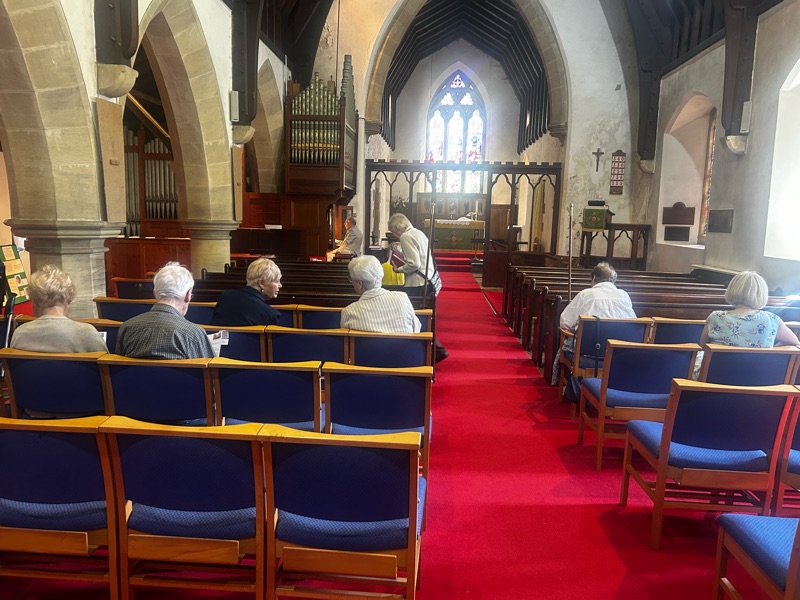
More seriously, in marriage you are there to support and cherish one another and that two have become one. So Andrea and Robbie, married in this church 60 years ago on the 30 April we celebrate with you today.


I like what one young husband whose wedding I conducted said about his new wife at the reception. He said:


“I asked her to marry me, not because I have found someone I can live with - but because I have found someone I cannot live without”


Some people have some very strange ideas about what marriage is all about.


Take Elizabeth Taylor – who after seven marriages and five divorces - said this:


“I think it’s fairly obvious why I was married. As strange as it may sound, I am a very moral woman. I was taught by my parents that if you fall in love, if you want to have a love affair, you get married. I guess I’m very old-fashioned.”


And some have even stranger ideas about what makes a good partner!


Take Agatha Christie, the famous novelist who once said: “ An archaeologist is the best husband a woman can have; the older she gets, the more interested he is in her.” She should know – she was married to one!


What is wonderful is that for Andrea and Robbie their marriage vows have meant a lot to them as 60 years have passed.


They have been through thick and thin together – working together to build a good life together and create a loving family.


The Scripture says: “Two are better than one because they gain a good reward in their toil. For if one will fall, the other will lift his companion but woe to the one alone who falls when there is no other to lift him up! So if two lie together, they keep warm, but how can one alone keep warm. Although one may prevail against him who is alone yet two will hold out against him, a threefold cord is not easily broken. That’s Ecclesiastes.


Then what about Diamonds on a Diamond Anniversary?  They say diamonds are forever. I bet you are singing it in your head with your very best Shirley Bassey impression…


Diamonds are indeed one of the hardest, most enduring substances on earth, (although whether they will actually last forever, only God knows).


They are not only highly valued as gemstones, with their clarity, cut and brilliant ability to scatter light, they are also used as cutting tools in a great number of industries. In fact the vast majority of diamonds mined today are used this way.


To reach a 60th wedding anniversary is a wonderful achievement, especially in today’s world. Like a diamond, a long lasting marriage is a rare and beautiful thing. That diamonds are also symbols of endurance and resilience is also apt. Marriage needs those too?


Andrea and Robbie’s marriage has been an amazing example of love, faithfulness and devotion. Towards each other, to their ever growing family, to their friends, to those in need – and most importantly, to God. Their marriage has lasted because God brought them together and God has kept them together. And those of us here this morning are extremely grateful for that.


I read somewhere that diamonds are ‘symbols of purity, unity, love, wealth and abundance’. How fitting then to be used in reference to a long lasting marriage - both are priceless gems that have stood the test of time. The world has changed a lot since 1966. 

1966 in the UK was defined by cultural highs and tragic lows: England won the FIFA World Cup, "Swinging London" was at its zenith, and The Beatles made headlines, but the nation was devastated by the October 21st Aberfan disaster, which killed 144 people in South Wales. Politically, Harold Wilson’s Labour Party secured a landslide, and the nation began preparing for decimalization. But love is love whatever the year.


For the purpose of this sermon I researched if diamonds were mentioned in the Bible and found, interestingly, that there is some division of opinion. Different words have been translated as ‘diamond’ in different translations.

 Some commentators believe the sea of crystal glass that John described seeing before the Throne of God in Revelation was actually made of diamonds. If so – diamonds will be forever, I suppose!


I think the most important thing is to recognise that for anything to have true lasting worth it has to be given over to God. God can take a marriage full of human frailty and make it into a monument to His goodness and faithfulness. The true worth of a diamond only comes in it’s cutting and shaping. God can take any one of us – like uncut pieces of rock mined from the earth – and through His work in us, cutting, shaping, forming, polishing – make our lives into something pure, valuable and beautiful. And our lives, formed and shaped by Him, will indeed last forever, to shine and reflect His glory for eternity.


But sometimes we need a warning because it can go wrong.


Jesus has ushered in the kingdom of God, and it is up to us to listen and watch for the Spirit to speak and move among us, leading us to receive what God has done in Jesus and continue to build the body of Christ.


Go back to Acts and read the story of Stephen’s martyrdom. The people hurling those stones weren’t strangers or foreigners or a band of terrorists; no, they were upstanding citizens—the kind of people who, had they lived today, said their prayers every day and went to church. But they in public didn’t live up to the calling Christ commands because it is too radical.


When we stop listening to one another; when we stop listening for the Spirit; when our concern is focused on the preservation of the self, rather than the flourishing of all, our own faith becomes impoverished, and the Gospel is polluted and lessened.


Jesus has called us to build his kingdom and he has entrusted us with all the tools we need to do it. In the end, one response requires us to live our life so that we may participate in God’s resurrected life…


…And the other? It will quite literally kill us.


Andrea and Robbie as you absorb and reflect the light of Christ, you will find that your destiny together will participate in the very glory of God in the world. And you will look a lot like the new Kingdom as described in Revelation 21:11, “…

And the holy city, coming down out of heaven from God. It had all the glory of God, and glittered like some precious jewel of crystal clear diamond.”Your marriage can be a part of that sparkling kingdom. Maya Angelou writes beautifully about love in her book, I Know Why the Caged Bird Sings. She said that to really love someone is to know the song their heart sings and to hum it back to them on the days they forget how it goes.


Perhaps when we know that we are loved by God in the fullness of God’s knowledge of us we are free to live in this love. 

TFree to transmit the love of Christ in a hurting world.  Free to see ourselves and others as God sees us. Because loved people love people. How radical, to see each person, as God sees them. .


A naughty vicar in marriage preparation classes said this once “Grooms, once you get married remember that when you have a discussion with your future wife, always get the last two words in…Yes, dear.”


And Prince Philip speaking on his Diamond Wedding in 2007 said this "I think the main lesson we have learned is that tolerance is the one essential ingredient in any happy marriage... You can take it from me that the Queen has the quality of tolerance in abundance."


And a couple celebrating their Diamond Wedding laughed together “60 years of annoying the same person, who’d have thought it?”


Andrea and Robbie, your love for each other is clear and is an inspiration. Thank you for letting us share your celebration today. 60 years is a diamond legacy, rare, precious and enduring. May your example inspire us all. In Jesus name who shows us in his life what love is and invites us all to live in his way. Amen.


Saturday, 18 April 2026

Walking the 2026 Emmaus Road

Walk beside us risen Jesus…

On the Emmaus road of life
On the journey of confusion
On the road of questions
On the way of disappointment
When we do not understand.

Walk beside us, risen Jesus
On the Emmaus road of life
In the guise of the stranger
In the unfamiliar traveller
In the unexpected guest
When we feel almost overwhelmed.

Walk beside us, risen Jesus
On the Emmaus road of life
Give us insights beyond our knowing
Give us a glimpse of your will at work
Give us strength to keep on keeping on
When our hope is almost gone.
Amen.

Lord Jesus,

Just as You walked with the disciples on the road to Emmaus, walk with me on my journey today.

When I am confused, open my mind to understand. When I am weary, lift my spirit with Your presence. When I am doubtful, reveal Yourself in the breaking of the bread.


You are the Companion who listens when no one else does, the Teacher who explains truth when my heart is clouded, and the Savior who stays when the night falls.

Help me recognize You in the ordinary moments of life— in the stranger, the Scriptures, the Sacraments.

Let my heart burn with joy as You speak, and let my eyes be opened to Your love in every step.

Stay with me, Lord, for it is nearly evening. Shine Your light on my path, and guide me safely home to You. Amen.

I have been reminded this month that I’ve been leading worship in Methodist Churches for forty years. Forty years ago you wrote out your service by hand with a bottle of tippex next to you to correct your mistakes. You also took the whole serviceyourself - from a pulpit - and no one else helped you apart from an organist. 


Maybe I’ve preached on this Emmaus Road post Easter story more than any other. The miracle is I find new things to say about it every year.


In this most wonderful of stories in Luke’s Gospel, we accompany two of Jesus’ disciples as they first walk with and then eat with the risen Jesus. It is an encounter that will change their lives forever. Their story is a wonderful example of how God reveals himself to us too.

The two disciples are walking, down-cast and sad. Maybe they just can’t cope with the grief of their other friends and just need space. Jesus, the one in whom they had placed so much hope is dead, killed at the hands of those they had thought he had come to overthrow. 


Maybe they “just wanted to go home.” Have you ever said that when something has gone badly wrong, a holiday where the hotel was awful, a meal out that was inedible, being stuck in a long traffic jam… “I just want to go home.” 

And so when Jesus comes alongside them they are in no place to recognise him, even though there are strange rumours circulating that his body is missing and angels have appeared to say he is alive.

Note what Jesus does first. He does not reveal himself in a blaze of glory. He does not ignore their experience or their feelings of sadness. Instead, he gets them to tell their story, and he listens. 

How could this have happened? Had he been taken? What are we to do now? Where do we go from here? The two disciples have a while—seven miles—to roll these details over, to ruminate on this loss and wonder at these strange occurrences, as they trudge on to Emmaus. “Really’s?” and “what if’s” animate their footsteps amidst exhaustion and abandonment.

“But we had hoped he was the one to redeem Israel.” It’s a statement saturated with honesty and pain—a confession of sorts. This was the One who was to restore Israel, to lift up the lowly and fill the hungry with good things. This was the One for whom generations had longed, hope built upon hope for centuries. And this One finally had a face. Now, even after his death, that face was gone, vanished from view. Imagine the weight of grief. Imagine the intensity of loss. Imagine all that compounded by utter confusion.

It might not be all that hard to imagine, honestly. The Emmaus road is one likely familiar to many of us, this side of heaven. It’s a well-worn path, dotted with defeat and disappointment, marked by inevitable questions, and disbelief. Life seasons and circumstances often determine how steep or winding or rocky this road is, but many of us have probably trod it, whether in the past or in the present.

The beauty we experience week in and week out in the scriptures is that the living God meets us on this road. The living God comes alongside us unexpectedly in moments of loss and difficulty. The living God walks with us in times that tempt despair and despondency, whether we realize it or not. And this is precisely what Cleopas and his friend or his wife experience on the Emmaus road, as they encounter a stranger mid-step.

There can often be the temptation when people are sad or low to try and “cheer them up” without giving them the space or time to talk first. Jesus listens. He values their experience. He gets them to reflect on what they have experienced over the last few days in Jerusalem.

It is an important starting point for all of us in pastoral work

Like in that well-known poem of footsteps in the sand, we can sometimes as we look back discover that those times when we felt we were walking alone, when there were only one set of footprints, not two, in the sand, were in fact those times when God was carrying us, not when he had left us. 

As he did with the two on the road to Emmaus, Christ invites us to set aside time, maybe even just five minutes a day, to reflect on our day and discern his presence. As we do so, we will come to see him and experience him more and more in our daily lives.

And often pastoral care starts with a mess and a longing for help. 


Of course, by the time they get home, about seven miles walk, a long and winding road, they don’t yet know who the stranger is who has walked with thembut they have been so captivated by him and it is getting late they plead with him to stay with them. They feed him dinner, and they recognise him in the breaking of the bread.

It’s amazing how many of these resurrection appearances revolve around food—and people gathered around food. Jesus even makes the disciples breakfast on the seashore in John’s gospel. As an old theology professor used to say to his students, “Jesus loved meals so much, he became one.” 

I want to just think about three reactions these two have after seeing it was Jesus who’d walked and now broke bread with them. 

First, they say “weren’t our hearts on fire as he talked with us on the road?”

What does it mean to have a burning heart? The Greek word Luke uses here (kaiō) means ‘to set fire to’ and is used here metaphorically of the human heart being set on fire for God. It means more than simply being ‘enlightened’. 

It means being ‘set ablaze’ with understanding of, and enthusiasm for, God and the things of God. We are reminded of John Wesley’s testimony to his conversion on the 24 May 1738: ‘In the evening I went, very unwillingly, to a society in AldersgateStreet, where one was reading Luther’s preface to the Epistle to the Romans. About a quarter before nine, while he was describing the change which God works in the heart through faith in Christ, I felt my heart strangely warmed. I felt I did trust in Christ, Christ alone, for salvation; and an assurance was given me that he had taken away my sins, even mine, and saved me from the law of sin and death.’ 


John Wesley is reputed to have advised his fellow Methodists to ‘Light yourself on fire with passion, and people will come from miles to watch you burn!’

A Minister was roused from his sleep one night by the police with the news that his church had caught fire. Hurrying to the scene he found the fire brigade quickly bringing the fire under control. Apparently more serious damage had been averted by the prompt and zealous action of a man who lived just across from the church. He had spotted the fire, phoned the police and fire brigade, and also managed to put out a good proportion of the fire by the time the fire brigade arrived. Visiting the man a few days later, to thank him for his invaluable help and assistance, the Minister inquired as to why he had not seen the man in church before since he lived so close. ‘Well.’ the man replied, ‘the church has never been on fire before!’

Post Easter, recognising him, are our hearts on fire? Or has our fire gone out? 


Then having trudged seven miles, they run seven miles back to see the others. Jesus disappears, but they don't linger in contemplation of their mystical experience. They get up. They go back to Jerusalem, right then. They find their community. Because recognition of Christ is not complete in isolation. It is completed in community.  


This matters for us right now. We live in a culture that tells us our value comes from what we produce, or what we own, or what we can accumulate. We're taught that might is right. That power should have its way. That security comes through acquisition, through accomplishment, through ascending.  

And Peter's letter to the early Christians speaks directly to it. You have been ransomed from the futile ways of your culture, Peter says. Not by silver or gold. Not by playing the game of power and accumulation better than anyone else. But by the death of Christ. By an encounter with a way of being human that stands in radical opposition to the world's logic. 

This is life. Not loyalty to the powers of the world, but loyalty to the Christ who walks the dusty road with us, who breaks bread with us, who gathers us into community.  Like the disciples, we need to learn that salvation doesn't come through wealth and power; it comes through the vulnerability and self-giving love. Love above all else.

We're called to be that love-shaped community, practising a way of life that stands against the logic of the world. We're called to be a community that builds the alternative together, and as we carry the things of God along the dusty roads of this world, aspiring to something greater, we'll find the risen Christ with us.

Listening. Teaching. Interpreting the scriptures, and making sense of our lives. In weeks like this one in the news, we can get bogged down and hopeless. We have lost the prophetic imagination to speak out of this mess and muddle of that hope and that promise.

We really need a language that knows where we have been and where we might get. We have to acknowledge the sheer

improbability of the idea that we might, with a little effort, be different and better than we are. Then, to hope as we must, we must accept that we need to be rescued.

And that is what the two travellers learned on the Emmaus Road.


And this story in 2026 for us? I wonder what I said about it in 1986? 

Well I’ll say this this year…

I think it summarises the Christian life. In fact, it summarises what we do every week and what we’re doing this Sunday.

Our calling is to proclaim the empty tomb with joy. But, like the travellers on the Emmaus road, we’ve fled with fear from the place of new life. Insteadwe’ve ploughed on in precisely the wrong direction. God, as always, takes the initiative and draws near, but we fail to recognise Jesus even when he’s staring us in the face. Jesus asks what things are burdening us and others, and hears our intercessions and prayers. The Word himself opens the words of scripture as we hear them read and preached. In sacraments like the breaking of bread, we glimpse God’s abundance and he nourishes the part of us that is for ever. We cry to the Lord when it seems darkness is closing in, and he tarries with us. Finally, our hearts burn with the fire of his Spirit, and we repent and change course.

Fear to joy; blindness to sight; unheard to understood; ignorance to enlightenment; despair to inspiration; hungry to filled with good things; disunity to community; lost to found. We need not put our hands in his wounds to believe: these things are the marks of the risen Lord, in whose company we walk, in these days of Easter, and forever.

This afternoon at Sawley using the old hymn book we will sing these words, surely our prayer for us today: 

Perchance we have not always wist

Who has been with us by the way;

Amid day’s uproar we have missed

Some word that Thou hast had to say,

In silent night, O Saviour dear,

We would not fail Thy voice to hear.


Day is far spent, and night is nigh;

Stay with us, Saviour, through the night;

Talk with us, touch us tenderly,

Lead us to peace, to rest, to light;

Dispel our darkness with Thy face,

Radiant with resurrection grace.


Alleluia.


Sunday, 5 April 2026

Easter 2026


I was at a pre Easter Day music and craft workshop yesterday at Snape chapel which I’m the minister of temporarily until September. We learnt some new Easter songs and one the music said we should do lively, and  with hope. Do you gather here lively, and with hope as we await the dawn? I did wonder what we would do as Storm Dave swirled last night as I wrote this. Did Mary go to the tomb lively and with hope? I suggest not.

According to John, Mary Magdalene, racked by grief and yet motivated by a fierce desire to be near the body of her Lord, went to the tomb. She was awake early. Only John tells us that Mary set out before dawn. Not when light was breaking or at “early dawn,” as Luke says but “while it was still dark” At night.

“Early on the first day of the week,” John says, meaning between 3 a.m. and 6 a.m., “while it was still dark” It’s important to John and it should be to us. Mary’s encounter with resurrection begins “while it was still dark.”

And when she gets to the tomb the darkness doesn’t go away. It’s intensified. She’s thrown into a different kind of darkness. She sees and yet she cannot see. She sees the tomb—did she have a lamp or a torch? —and by some source of light she discovers that the stone had been removed. She runs to Peter and an unnamed disciple, “the one whom Jesus loved”  we are told, she runs to tell them. “They have taken the Lord,” meaning the Lord’s body, “out of the tomb, and we do not know where they have laid him”

Consider this: Mary’s lost in double-grief. She lost him first on Friday, this man whom she loved and who loved her, and now she’s lost him again. “They” she says. One person cannot easily move a dead body. In the dark, confused, concerned, she assumes the worse. Wouldn’t you? Thomas Lynch reminds us—Lynch is a funeral director and author who writes beautifully, movingly, with a wry sense of humour about daily encounters with death and loss, as a Christian—he says, that as general rule, dead folks don’t do a lot for themselves. They can only have things done to them.And that’s where Mary’s thoughts go.

She didn’t go to the tomb in the dark expecting him to be gone. And she certainly didn’t expect him to be alive. Sure, Jesus talked about rising again, but Jesus said a lot of things that were confusing and not especially clear to his disciples. She wasn’t looking for resurrection. It wasn’t on her horizon of expectations. As T. S. Eliot said, there are things, “Not known because not looked for.” 

When the men get to the tomb, they’re just as perplexed and confused. No one’s sure what’s going on or what’s going to happen next. They have a look around and then they leave Mary there all alone. Crying. Weeping. Heartbroken. She finally goes into the tomb. And then I love how John phrases this: “As she wept, she bent over to look into the tomb… That’s when she really sees what’s missing. “As she wept, she bent over to look into the tomb…” 

She doesn’t run from her tears or fears. They guide her deeper into the darkness. She sees the place where the body once laid. She sees the graveclothes. And she gets to see something the men don’t see: two angels sitting where the body was placed, one at the head and the other at the feet.

Mary doesn’t seem too bothered by the fact that she’s seeing angels and having a conversation with them.It’s already been an odd day, so why not angels too? But now, at least, someone bothers to ask, “Woman, dear one, why are you weeping?” They have taken away my Lord…” Again, we don’t know who “they” are, but it doesn’t matter. They have taken away her love. 

And it’s at that moment, in the depths of her sorrow and grief, unable to see clearly what’s going on around her, confused by darkness and despair, that Jesus arrives. He kind of sneaks up on her. He doesn’t startle or surprise her, but quietly stands there. That’s how the Resurrected One often shows up in John’s Gospel. He sneaks in behind closed doors to disciples locked away in fear  He appears from out of nowhere and fixes breakfast for his friends on the lakeshore and they don’t recognize him at first “Not known, because not looked for.” Mary confuses him for the gardener. “Woman, dear one, why are you weeping?” He speaks to her with profound respect. He doesn’t say, “Stop crying.” He doesn’t judge her. Mary!” he said. “Mary!” And then all becomes clear. Shadows slowly begin to scatter. His voice a light that pierces the darkness and brings her back to herself. His familiar voice a light that calls her by name because he loves her, in calling out her name, he calls—not unlike Jesus calling Lazarus out from his tomb calls her to step out into his light, the light of a new day, a new life, a new joy, a new way. that’s what resurrection means, that’s what resurrection does and continues to do


In John’s Gospel, Jesus says, “I have come as light into the world, so that everyone who believes in me should not remain in the darkness” (Jn. 12:46). And go back to the beginning of John, in his sublime prologue, we find these words: “What has come into being in him was life, and the life was the light of all people. The light shines in the darkness, and the darkness did not overcome it” For, resurrection has a way of emerging from within darkness.

While it was still dark… While it was still dark…Mary Magdalene went to the tomb.

On this Easter morning, may we, like Mary, rediscover or perhaps discover for the first time, there is a light that shines in the darkness, a light the darkness can never overcome. There is a voice that illumines our darkness and our grief. There is One who knows our name and calls us to step out, step into the light of a new day. Lively, and with hope…

Christ is risen! Risen indeed!