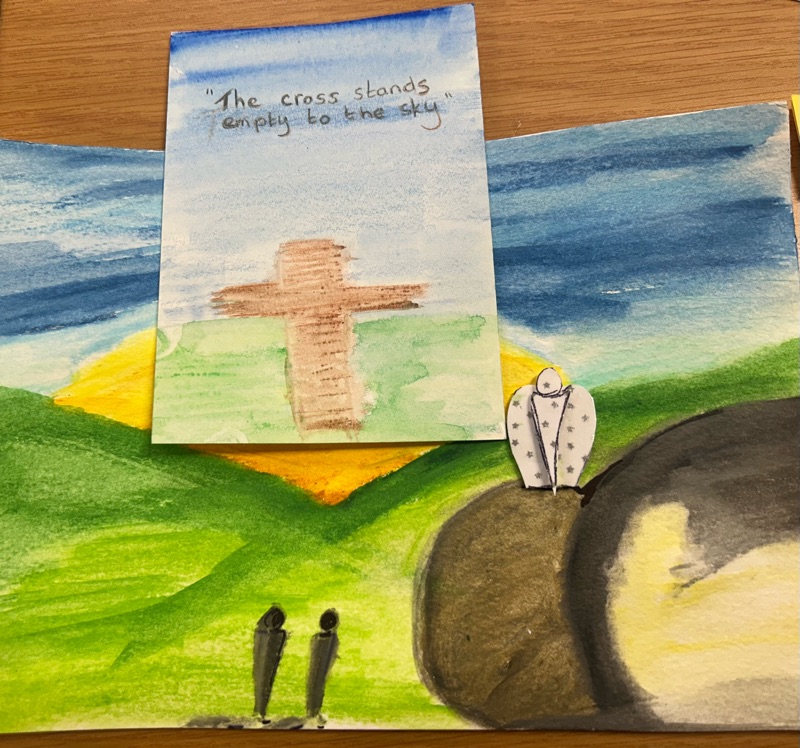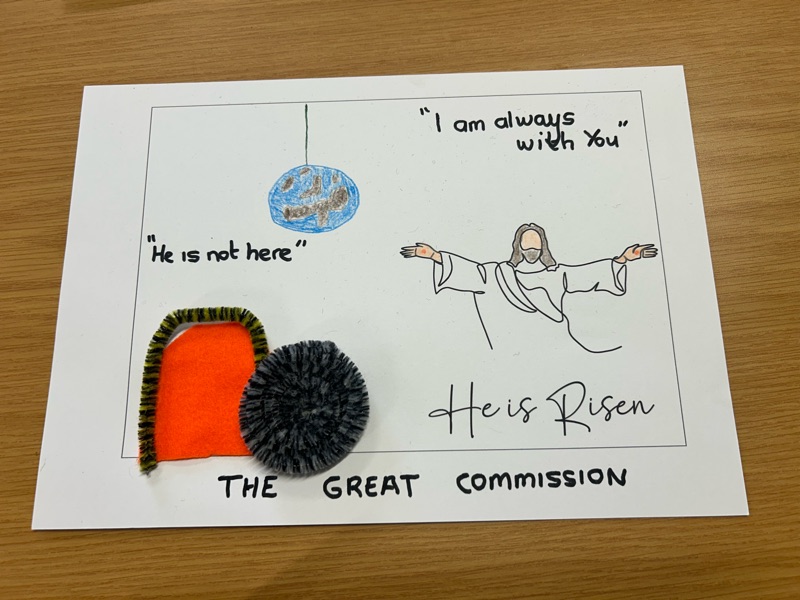
I was at a pre Easter Day music and craft workshop yesterday at Snape chapel which I’m the minister of temporarily until September. We learnt some new Easter songs and one the music said we should do lively, and with hope. Do you gather here lively, and with hope as we await the dawn? I did wonder what we would do as Storm Dave swirled last night as I wrote this. Did Mary go to the tomb lively and with hope? I suggest not.
According to John, Mary Magdalene, racked by grief and yet motivated by a fierce desire to be near the body of her Lord, went to the tomb. She was awake early. Only John tells us that Mary set out before dawn. Not when light was breaking or at “early dawn,” as Luke says but “while it was still dark” At night.
“Early on the first day of the week,” John says, meaning between 3 a.m. and 6 a.m., “while it was still dark” It’s important to John and it should be to us. Mary’s encounter with resurrection begins “while it was still dark.”
And when she gets to the tomb the darkness doesn’t go away. It’s intensified. She’s thrown into a different kind of darkness. She sees and yet she cannot see. She sees the tomb—did she have a lamp or a torch? —and by some source of light she discovers that the stone had been removed. She runs to Peter and an unnamed disciple, “the one whom Jesus loved” we are told, she runs to tell them. “They have taken the Lord,” meaning the Lord’s body, “out of the tomb, and we do not know where they have laid him”
Consider this: Mary’s lost in double-grief. She lost him first on Friday, this man whom she loved and who loved her, and now she’s lost him again. “They” she says. One person cannot easily move a dead body. In the dark, confused, concerned, she assumes the worse. Wouldn’t you? Thomas Lynch reminds us—Lynch is a funeral director and author who writes beautifully, movingly, with a wry sense of humour about daily encounters with death and loss, as a Christian—he says, that as general rule, dead folks don’t do a lot for themselves. They can only have things done to them.And that’s where Mary’s thoughts go.
She didn’t go to the tomb in the dark expecting him to be gone. And she certainly didn’t expect him to be alive. Sure, Jesus talked about rising again, but Jesus said a lot of things that were confusing and not especially clear to his disciples. She wasn’t looking for resurrection. It wasn’t on her horizon of expectations. As T. S. Eliot said, there are things, “Not known because not looked for.”
When the men get to the tomb, they’re just as perplexed and confused. No one’s sure what’s going on or what’s going to happen next. They have a look around and then they leave Mary there all alone. Crying. Weeping. Heartbroken. She finally goes into the tomb. And then I love how John phrases this: “As she wept, she bent over to look into the tomb… That’s when she really sees what’s missing. “As she wept, she bent over to look into the tomb…”
She doesn’t run from her tears or fears. They guide her deeper into the darkness. She sees the place where the body once laid. She sees the graveclothes. And she gets to see something the men don’t see: two angels sitting where the body was placed, one at the head and the other at the feet.
Mary doesn’t seem too bothered by the fact that she’s seeing angels and having a conversation with them.It’s already been an odd day, so why not angels too? But now, at least, someone bothers to ask, “Woman, dear one, why are you weeping?” They have taken away my Lord…” Again, we don’t know who “they” are, but it doesn’t matter. They have taken away her love.
And it’s at that moment, in the depths of her sorrow and grief, unable to see clearly what’s going on around her, confused by darkness and despair, that Jesus arrives. He kind of sneaks up on her. He doesn’t startle or surprise her, but quietly stands there. That’s how the Resurrected One often shows up in John’s Gospel. He sneaks in behind closed doors to disciples locked away in fear He appears from out of nowhere and fixes breakfast for his friends on the lakeshore and they don’t recognize him at first “Not known, because not looked for.” Mary confuses him for the gardener. “Woman, dear one, why are you weeping?” He speaks to her with profound respect. He doesn’t say, “Stop crying.” He doesn’t judge her. Mary!” he said. “Mary!” And then all becomes clear. Shadows slowly begin to scatter. His voice a light that pierces the darkness and brings her back to herself. His familiar voice a light that calls her by name because he loves her, in calling out her name, he calls—not unlike Jesus calling Lazarus out from his tomb calls her to step out into his light, the light of a new day, a new life, a new joy, a new way. —that’s what resurrection means, that’s what resurrection does and continues to do!

In John’s Gospel, Jesus says, “I have come as light into the world, so that everyone who believes in me should not remain in the darkness” (Jn. 12:46). And go back to the beginning of John, in his sublime prologue, we find these words: “What has come into being in him was life, and the life was the light of all people. The light shines in the darkness, and the darkness did not overcome it” For, resurrection has a way of emerging from within darkness.
While it was still dark… While it was still dark…Mary Magdalene went to the tomb.
On this Easter morning, may we, like Mary, rediscover or perhaps discover for the first time, there is a light that shines in the darkness, a light the darkness can never overcome. There is a voice that illumines our darkness and our grief. There is One who knows our name and calls us to step out, step into the light of a new day. Lively, and with hope…
Christ is risen! Risen indeed!