Gervaise Phinn in his poem about a school nativity play has this line:
Oh Miss, I don’t want to be Joseph,
Miss, I really don’t want to be him,
With a cloak of bright red and a towel on my head
And a cotton wool beard on my chin.
Would we want to be Joseph? That’s my question for today. I had an idea we might look at his part in the Christmas story today…
I wonder if you can think of a time in the last year or so when your best laid plans are suddenly and unexpectedly derailed.
Imagine, then, what it must have been like for Joseph when his fiancée Mary came to him with her news of pregnancy.
There are some basic facts that we know about Joseph from the bible and there are others that church tradition adds.
Firstly, we know that Joseph could trace his roots back to King David and beyond – the gospels of Matthew and Luke both contain genealogies of Jesus and the one in Matthew is traced back to David and Abraham, through Joseph.
Joseph is of long-standing Jewish heritage – this is important as the prophets such as Isaiah had spoken that the coming messiah, the one that would save the people, would come from David’s line, from ‘the root of Jesse’ (David’s father). Joseph came from that line.
It is often assumed that Joseph was a carpenter by trade and that he passed on his trade to Jesus, but the word used to describe Joseph’s occupation in the Greek was Tekton which means artisan or builder. An artisan or builder could work in wood but, interestingly, the term could also describe a stonemason.
To these basic facts church tradition tells us that Joseph was quite a bit older than Mary and when he is depicted in church art he is often shown that way – Joseph is shown as a mature man whereas Mary is always thought to have been not much more than a teenager.
If you speak to Roman Catholic friends who believe Mary remained a virgin her whole life and yet there’s a verse in Scripture that Jesus had brothers and sisters, they explain that away saying Joseph was married before and they were his children.
One reason Joseph is thought to have been much older than Mary is because he is not mentioned in the gospels after the time Jesus is twelve and Joseph and Mary find him in the temple teaching the scribes. He does not feature again, and it is thought that he died before Jesus started his ministry.
Although we have little factual information about Joseph, we have more about his character.
Matthew tells us that Joseph was a ‘righteous man’. That means he took his faith seriously – that he tried to live rightly under God’s law. He tried to do ‘the right thing’ in life.
Joseph surely imagined his life unfolding in very normal ways: continuing his trade, marrying Mary, raising children, remaining part of the Jewish community he knew and loved. All very reasonable hopes.
And so when this happened, what is this ordinary working man to do:
‘When Mary had been engaged to Joseph, but before they lived together, she was found to be with child from the Holy Spirit’ (v.18)
His life is abruptly upended. Mary is pregnant – and Joseph knows howthat happens. We can only imagine how the conversation when Mary broke the news to Joseph went.
In the eyes of the community this would mean disgrace, shame, and scandal, not only for Mary but for Joseph and his family as well. Jewish marriages were in two parts, with a betrothal ceremony (rather like an engagement) and then the marriage. There was likely to have been vows of celibacy at the betrothal. Breaking these vows would have consequences.
So, what is this ordinary, righteous, quiet man to do?
We often tidy this moment up in our nativity plays, glossing over the emotional cost.
Joseph may well have wrestled for weeks with the decision. There may have been many sleepless nights as he weighed the law, his reputation, Mary’s safety – what is ‘the right thing’ in this situation. Eventually, he decides on a course of action that is both lawful and merciful: he will dismiss her quietly, without fanfare or public shame.
And it is into this confusion and in the dead of night during a dream that Joseph has his annunciation. In Joseph’s dream the angel of God reveals that Mary’s child is indeed from God, that Joseph should not be afraid to take her as his wife – the child has been sent to deliver the world from its sins in fulfilment of the messianic prophecies.
Joseph’s response is striking for what it lacks. There are no questions. No objections. No songs or speeches of faith or doubt. Joseph answers the call placed on his life without a single recorded word.
‘When Joseph awoke from sleep, he did as the angel of the Lord commanded him.’ (v.24)
He takes Mary as his wife. He names the child Jesus. He adopts Jesus and raises him as his own.
Joseph had a choice to make – he could have said no and dismissed Mary – but he did the right thing and said ‘yes’ to the call on his life and in that moment he steps away from any hope of an ordinary, uncomplicated life. Without Joseph’s yes, Mary and her newborn son would have been unprotected in the world. Would they have even survived – it is unlikely.
So, what can Joseph’s story teach us?
Joseph’s story is one of faithfulness without fanfare. He is an example of obedience, courage, and remarkable trust, lived out quietly and through actions rather than words.
Faithfulness is often easy when life is going well, when our carefully laid plans unfold as expected. But what about when they don’t? When illness, loss, redundancy, or unexpected responsibility changes everything?
Sometimes faithfulness looks like staying when it would be easier to walk away. Sometimes it means allowing ourselves to be changed by circumstances we did not choose, trusting that God is still at work even when the future looks nothing like we imagined.
Joseph reminds us that you don’t have to be in the spotlight to matter.Many of the people who shape the world for good do so without applause. They are faithful, steady, courageous in quiet ways.
Joseph teaches us that faithfulness matters. Obedience matters. Quiet trust matters.
God our Father,
who from the family of your servant David
raised up Joseph the carpenter
to be the guardian of your incarnate Son
and husband of the Blessed Virgin Mary:
give us grace to follow him
in faithful obedience to your commands;
through Jesus Christ your Son our Lord,
who is alive and reigns with you,
in the unity of the Holy Spirit,
one God, now and for ever.
So faithfulness to his betrothed, forced to get to Bethlehem for a census, a long journey to plan and endure, no room, finding somewhere to stay, being there witnessing birth in a cattle shed and receiving some interesting visitors. Joseph surely hoped for peace. But like the Christmas episode of Eastenders, which is always dark and someone is usually murdered Christmas for Joseph after some wise men have visited turns very very dark indeed…

I can imagine Joseph saying when another angel comes to him “I can’t take much more!” Joseph is now dragged into politics and threat. The wise men have journeyed to find Jesus and they’ve rattled King Herod. The writer Kate Compston says “We call them wise and I had always thought of them that way respecting the pilgrimage of anyone who sees a star and follows it to his discomforting being prepared to change.
And yet - in following their star, the star that was to lead them to enlargement of the soul (their own) they blundered mightily, and set in train the massacre of many innocents. Naive and foolish men they were, not wise to go and ask of Herod “where is your rival? where is he who might unseat you?”
The people knew about Herod. They were well aware of how dangerous life can be when a powerful ruler with a fragile ego is afraid. So everyone was on edge — anxious about what the paranoid king might do.
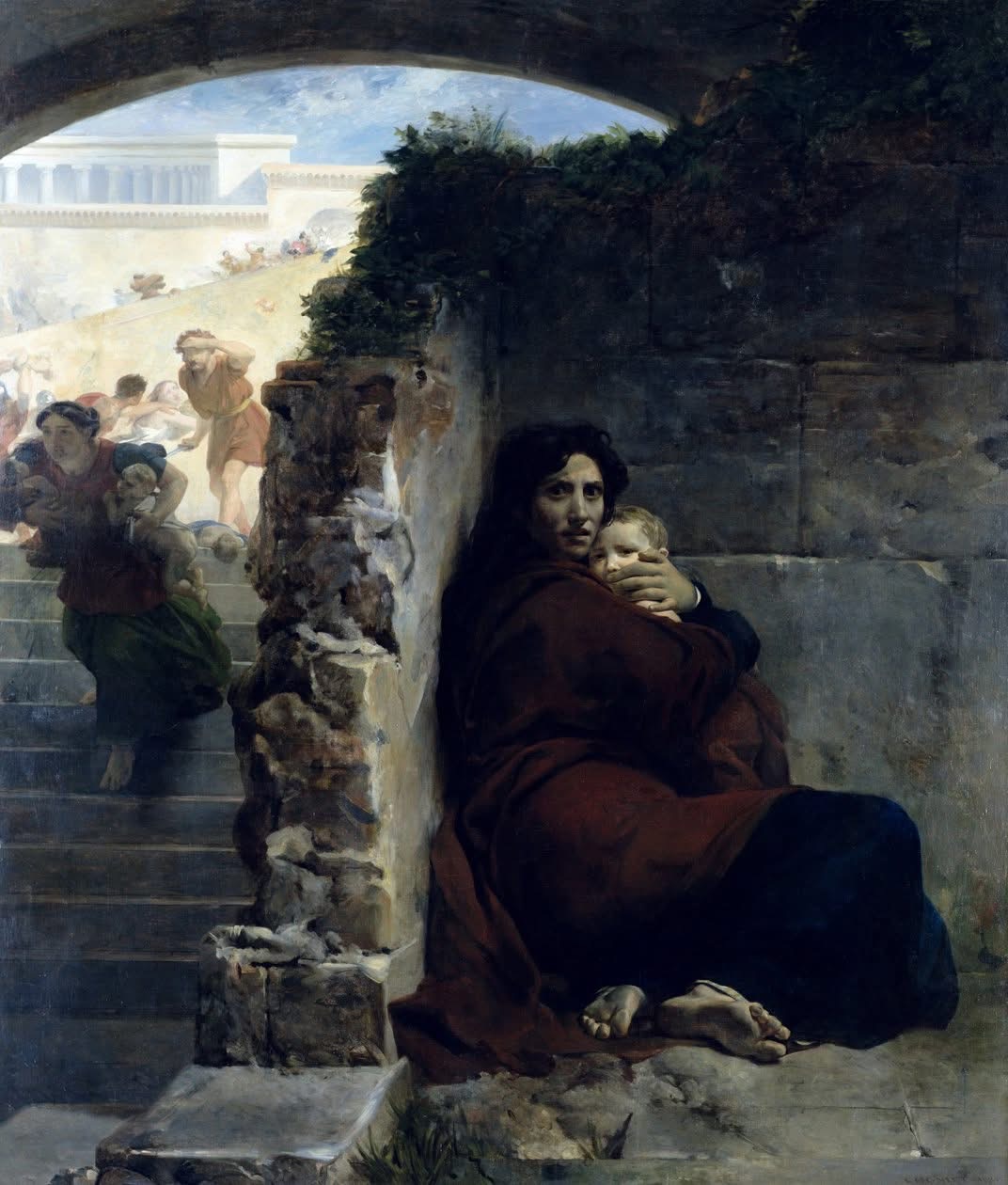
What Herod did was commit one of the greatest crimes in the Bible — we call it the Slaughter of the Innocents. Though it’s true we have no corroboration of this atrocity outside of Matthew’s Gospel, the account is in keeping with what we know about Herod’s ruthless methods. Matthew tells us that the paranoid king sent death squads to Bethlehem with the ghastly instructions to kill all male babies under the age of two.
One writer I read says that she has been privileged enough to visit the tomb of the massacred children in Bethlehem. “And when I go there, I was surprised to see how few they were: probably 10 to 15 in number. What was I expecting? Maybe hundreds of little tombs. But actually, the small number of these tiny tombs brought home the power of the story for me. A little Middle Eastern village, invaded by soldiers, taking all the children together and killing them in front of their mothers and fathers and brothers and sisters and grandparents. The barbarity of that act in that close knit community where everyone would have known everyone else was cruel in extremity.”
It’s horrible but it reminds us Christmas comes in the dark. And what of Joseph? Well Joseph becomes protector again. The angel tells him to get Mary and Jesus away quickly. Jesus himself was a refugee, displaced from his homeland by politics. And we say this story has nothing to say about the world today.How did they get to Egypt? This is where my preparation went a bit mad. Here’s what Egypt on line tour website says:
The overland journey, approximately 300 miles, would have taken perhaps a month, considering a donkey's average travel of 12–15 miles per day.
However, a more probable route would have been by sea. Traveling the 40 miles from Jerusalem to Jaffa, they could have taken a boat to Alexandria.
This 285-mile journey at a sailing speed of roughly 8 miles per hour would have taken less than two days. The gold from the Magi likely afforded them this option. Furthermore, the urgency of the angel's warning suggests time was critical. An overland journey risked being overtaken by Herod's soldiers. Traveling to Jaffa in two days and then by sea would have quickly placed them beyond Herod's reach.
How long did they stay in Egypt? We think about two to three years until Herod died.
This is the other side of Christmas, the other side of the angels and shepherds. Just as we celebrated joy and wonder in the lead up to Christmas, so we contemplate vulnerability and chaos and danger and frailty on this side of Christmas.
On the one side we have joy and confidence.
On the other side we have vulnerability and fear.
And standing in the middle of the two is the birth of the Messiah, our Saviour.
And what a wonderful metaphor that is for life. On one hand, we experience joys and wonders and amazements and peace. But on the other hand, we experience pain and suffering and loss and vulnerability.
How can we possibly make sense of the see-saw of emotions that life brings?
Well, we can only make sense of it if we put Jesus Christ, our Saviour, in the centre and allow the see-saw of life’s experience to pivot around him as the source of our Being.
If Jesus is at the centre of our lives, we can make sense of our joys and wonder and peace.
What words does Joseph speak into the Christmas story? None at all that we have. But without him things would have been very different.

No comments:
Post a Comment