
“What’s new?” The new is inviting, isn’t it, or is it scary or even unwanted? Three little scenarios…
The new is inviting… one of the folk who did our Advent course in Boroughbridge told us in one of the sessions about her puppy. She and her husband went out for the afternoon leaving said puppy loose with every door in the house open. They came back to find two huge bars of Dairy Milk under the Christmas tree eaten with bits of Christmas paper everywhere and upstairs a hidden large box of celebrations chocolates got into and chocolates and wrappers eaten. They had to rush puppy to the vets to get him to get his feast out of him. He saw new things to explore and it was fun at the time.
The new can be scary. You get an upgrade for your phone. It takes ages to work out how it works. Or is that just me? You start a new job and it might feel overwhelming as there’s so much to take in. When life’s circumstances hit us that change things, that can be frightening as we adapt to a new way of being.
There is a story told about a dialogue between a Bishop and a Churchwarden.
Bishop: How long have you held office? Warden: About forty years Bishop. Bishop: You must have seen a lot of changes in that time…
Warden: Aye, and I’ve opposed every one of them!
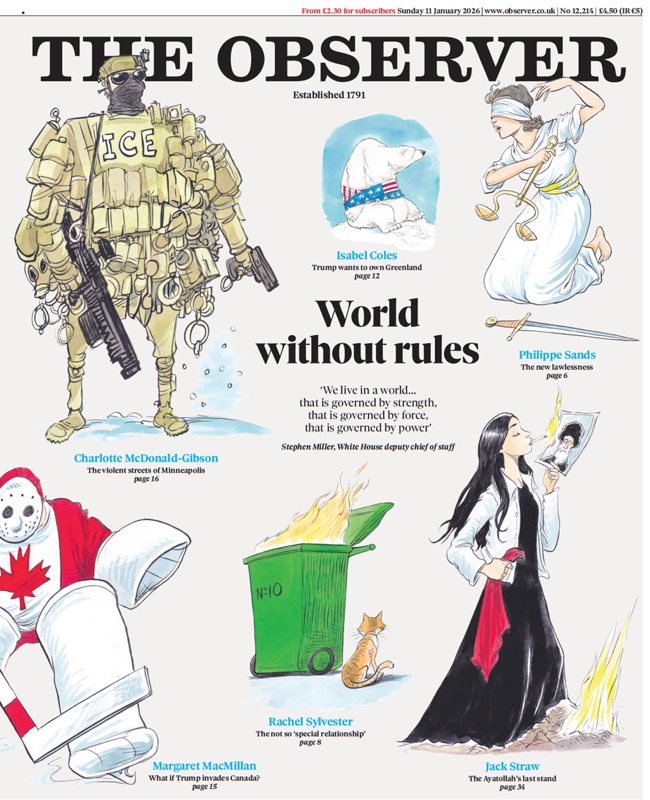
And yet… our faith says on this second Sunday of the New Year, on this first Sunday of Epiphany, don’t be negative or scared or block the new. God’s mercies are new every morning, great is his faithfulness even the world is spinning fast and spiralling out of control. What does the new brought on by a bomb or a threat mean for people? What about Venezuela, what about Gaza which has gone quiet, what about Ukraine, what’s going on in Iran? And bombs dropping on Syria now?
What are the people of Greenland thinking? Someone yesterday sent me a Matt cartoon. Two elderly people are sitting staring at an unopened box of chocolate biscuits. And one says to the other “my diets going badly, if I spot a biscuit it’s like Trump seeing Greenland.”
This season of Epiphany is literally a season to help us despite the world to be clear about the nature of God. We need time to think about what it means that Jesus has come. We had our Epiphany party at Grewelthorpe on Tuesday. One of the readings shared was called the party’s over and the author pleaded for time to think…
Here is the good news today. There is a new song. There is a new heaven and a new earth. Today. It’s new. It’s come. It’s for us. Right now.
“ O sing to the Lord a new song; sing to the Lord all the earth
Sing to the Lord, we say to all who will listen, bless his holy name; tell of his salvation from day to day”.
Rarely has that new song been more needed in our nation and in our world. Year by year, the earth’s climate is changing. We are living in the midst of the greatest human migration in history. In every country including our own there are questions of identity.
Who are we as a nation? Inequality grows year by year. We seem to be divided as a people. The world faces immense challenges.
What kind of a song are we called to sing as a Church in such a time?
When the world is being shaken, we must sing a new song of hope
When the world is hurting, we must sing the new song of healing and salvation.
When the world grieves, we sing new songs of resurrection.
When the world grows more unfair, we must sing God’s new song of justice.
To those who are enslaved and prisoners, we teach new songs of freedom
To those who are afraid, we share our songs of courage
To those who are dragged down by sin, we sing of God’s forgiveness
To those who are confused we sing God’s clear new song of truth
In this divided world, our songs reach out to strangers, to welcome and build bridges.
In this restless world, our songs tell of God’s peace and our final rest in heaven
In this polluted world, we sing a new song of care for God’s creation
In this world of vanity and pride, we sing songs of humility and meekness
In a world which lives for itself, we sing of love of God and neighbour.
The song we sing is the song of the gospel of Jesus Christ. It is a song of great power and love. Perhaps we do not sing it very well or as clearly as we could.
Perhaps we have forgotten its immense potential to transform human life. Perhaps we have lost confidence in the immense importance of the message entrusted to the Church. We need to find our voice again. We can’t do Christmas frivility all year – it will make us ill like that puppy with over excess.
But we need the song of the angels to be sung into 2026 don’t we? We need to be Jesus in our community. There is a cartoon circulating at the moment.
Jesus is with a crowd and he says blessed are the peacemakers, blessed are the poor in heart, blessed are the meek, and some wag in the crowd says “mate, what sort of Christian are you?” In every place, God calls us to sing a new song in the midst of this weary world.
Every year Radio 1 has a winner of the Sound of the year. This year it’s 22 year old Skye Norman. She said yesterday she has been singing since she could talk. She gave her first performance at the age of six, singing Cyndi Lauper's notoriously tricky True Colours at a school show.
"I don't know how, but my little voice managed to do it at the time," she laughed.
Before the song had even finished, she knew she'd devote her life to singing.
"It was just magical. It was my first time having an audience, and I felt so comfortable."
What new song are we singing?

Then someone new – something new – has come. Let me take you to our Gospel reading.
This is our good news, friends. The Spirit descends upon us, the heavens open, and God speaks – not with judgment, punishment, or condemnation, but with joy, grace, hope, love.
We are God’s beloved children – forgiven, claimed, named, baptized.
If you were to read Matthew chapter 3 in the original Greek, there’s something very interesting about the grammar its writer used. Throughout this gospel, the writer often uses the present tense to describe something that happened in the past. This is one such passage. So, the text doesn’t actually say, “Then Jesus came from Galilee.” It says, “Then Jesus comes from Galilee.”
It doesn’t say, “Then John consented”; it says, “Then John consents.” Scholars have discussed why these passages might have been written this way. Many people think that it is so we, the readers, feel that the action is happening right in front of us, and that we are a part of it. Today!
Even when we read the English translation of this passage, we get a sense of urgency and action.
It seems that the author of this text wanted us to be able to imagine ourselves as part of Jesus’s story. We can imagine ourselves standing outside of time, participating in the action.
At this point in the year, both in our culture and liturgy, we have left Christmas behind. The decorations in stores came down weeks ago, my friend posted with a picture of Easter eggs in Aldi “hurry, 12 weeks to Easter, get your eggs early” and, at church, we are in the season after Epiphany. Jesus isn’t a baby anymore. But, the power of Jesus’s human birth, the world-shattering effect of his Incarnation, remains still with us. Jesus took on our humanity in his birth and continued to share in what it meant to be human throughout his life - and the thing I find attractive about him is he transforms peoples lives on the spot by being alongside them. Incarnation doesn’t get put away with the tree.
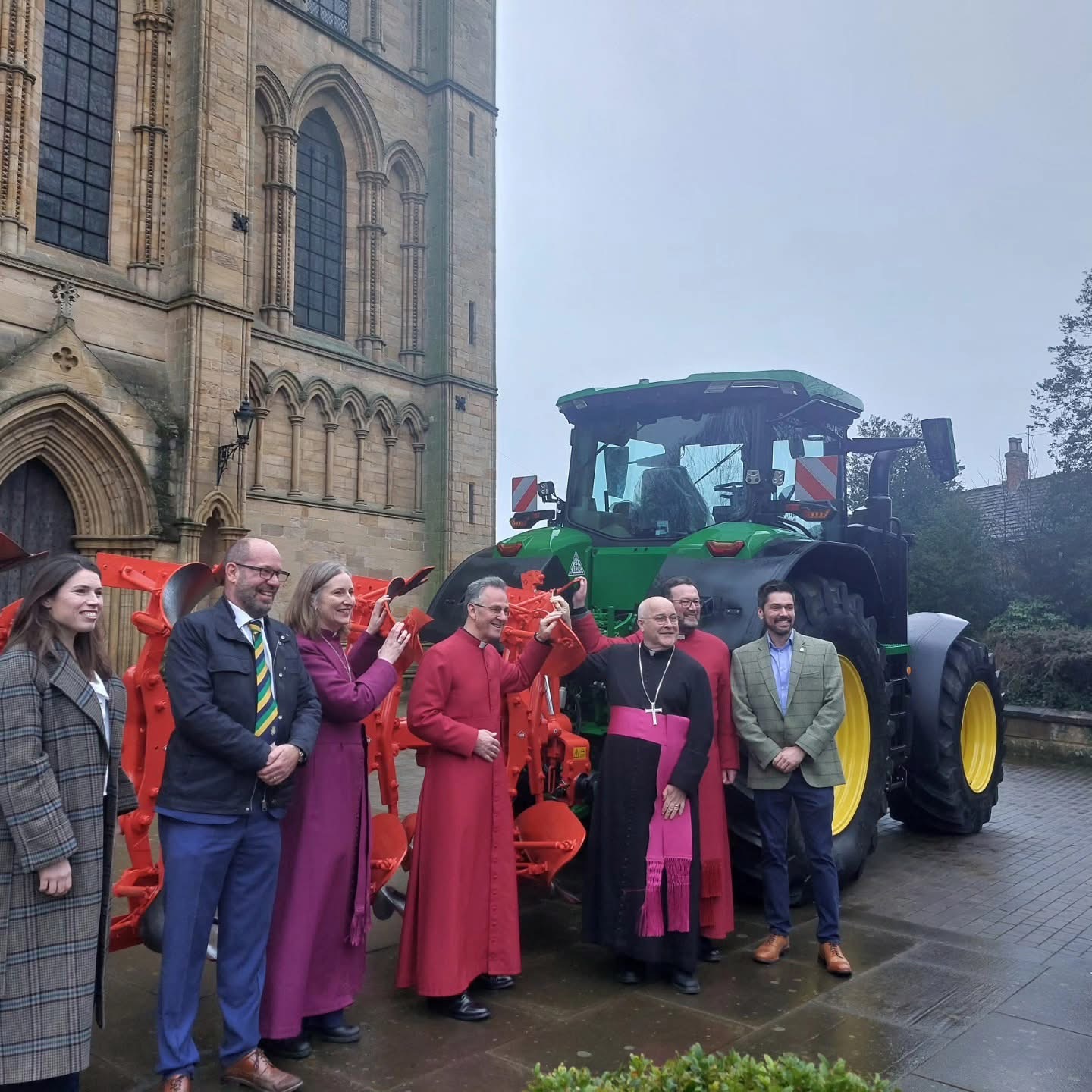
We sang it at Grewelthorpe on Tuesday the last carol of the season – while shepherds watched - its last line - the work of God has begun but never ceases, so I dare to suggest to us that the work of the church begins again this Sunday. We sing a new song. We share Jesus the new expression of God’s love. We do it in our worship together, we will do it this afternoon in the cathedral as we join the farming community to bless the year, we do it in pastoral care round hospital beds, we do it preparing and sharing baptisms and funerals, we do it at bereavement café which meets this Wednesday, we do it at coffee mornings, we do it planning the future with policy and hopeful vision together.
O sing to the Lord a new song. This is my son with whom I am well pleased. We are that crowd excited and inquisitive about this Jesus amongst us. This is your God.
This what the Church stands for: to live out the life given to all who seek to follow Christ the Lord - of whom Dr Matthews, the former Dean of St Paul's Cathedral wrote: "People knew where he had been because of the trail of gladness that he left behind him." I like to think that at best we, the Church, are part of that trail of gladness. That is what Epiphany is all about, and that is what we celebrate today. And through this year. Sing to the Lord a new song; sing to the Lord all the earth. Sing to the Lord, bless his name, tell of his salvation from day to day”.
The whole of creation as I said earlier is summoned to worship and to joy. The kingdom of God is breaking in: the kingdom of justice and mercy and peace. Not one day. But today.
Each day there are new blessings to appreciate, new wonders to discover, new adventures to be had. There is nearly always a new song to sing. So…
What’s new? Everything!

No comments:
Post a Comment